Quick answer
Our overall pick for a best HEPA air purifier is the Winix 5520, which offers AHAM-verified coverage and an auto mode with an air quality monitor. The other models suit those needing coverage for very large spaces, a 360-degree filter design, or an exceptionally quiet sleep mode.
Finding the best HEPA air purifier means matching a unit’s certified performance to your room size and needs. True HEPA filters are the standard for removing fine particles like dust, pollen, and pet dander. In this roundup, we compare manufacturer specifications for air purifiers with True HEPA filtration to highlight key differences in room coverage, smart features, and operation. For more on what to consider, see our general Air Purifier Buying Guide.
Our picks at a glance

Pros
- AHAM-verified coverage for a 392 sq. ft. room
- Includes air quality sensor and auto mode
- Washable pre-filter can be reused
- Carbon filter for reducing VOCs and odors
Cons
- The listing does not mention a specific sleep mode noise level
- Filter replacement schedule is not specified in the provided data
Pros
- High 235 CFM CADR for large rooms
- Quiet 30dB sleep mode
- Digital PM2.5 display and auto mode
- Includes child lock and timer
Cons
- Large physical footprint for placement
- The listing does not mention AHAM verification

Pros
- 360-degree air intake design
- Filter replacement indicator
- Listed as Certified HEPA
- Quiet 30 dB operation
Cons
- The listing does not mention an auto mode or air quality sensor
- Requires filter replacement every 6-12 months

Pros
- Very quiet 20dB sleep mode
- Real-time PM2.5 digital display
- Includes child lock and timer
- 360-degree air intake
Cons
- The listing does not mention CADR or AHAM verification
- Requires use of official brand filters for stated performance

Pros
- Large touch display with real-time PM2.5 feedback
- Ultra-quiet 20dB sleep mode
- Automatic mode adjusts fan speed
- Includes child lock
Cons
- The listing does not mention the filter's HEPA class or certification
- Filter needs replacement every 3 to 6 months
How we chose
Our editors selected these picks by comparing manufacturer listings and specifications on Amazon as of October 2026. We did not perform hands-on testing. We focused on key criteria: the presence of a True HEPA filter, the listed room coverage or CADR, noise levels for sleep modes, and the inclusion of features like air quality monitors and auto modes.
Best True HEPA Air Purifiers: our picks in detail
1. Best overall: Winix 5520 Air Purifier
The Winix 5520 is listed with an AHAM-verified clean air delivery rate for a 392 sq. ft. room and is stated to clean rooms up to 1,882 sq ft in one hour. It uses a True HEPA filter that captures 99.99% of particles as small as 0.01 microns, according to the listing.
Features include an advanced odor control carbon filter, a washable pre-filter, and an air quality indicator with LED lights. Its auto mode uses built-in sensors to adjust the fan speed based on real-time air quality measurements.
Best for: This is a strong choice for those seeking an AHAM-verified best HEPA air purifier with automatic adjustments and odor control.
Pros
- AHAM-verified coverage for a 392 sq. ft. room
- Includes air quality sensor and auto mode
- Washable pre-filter can be reused
- Carbon filter for reducing VOCs and odors
Cons
- The listing does not mention a specific sleep mode noise level
- Filter replacement schedule is not specified in the provided data
2. Best for very large spaces: SIESEAN H13 Air Purifier
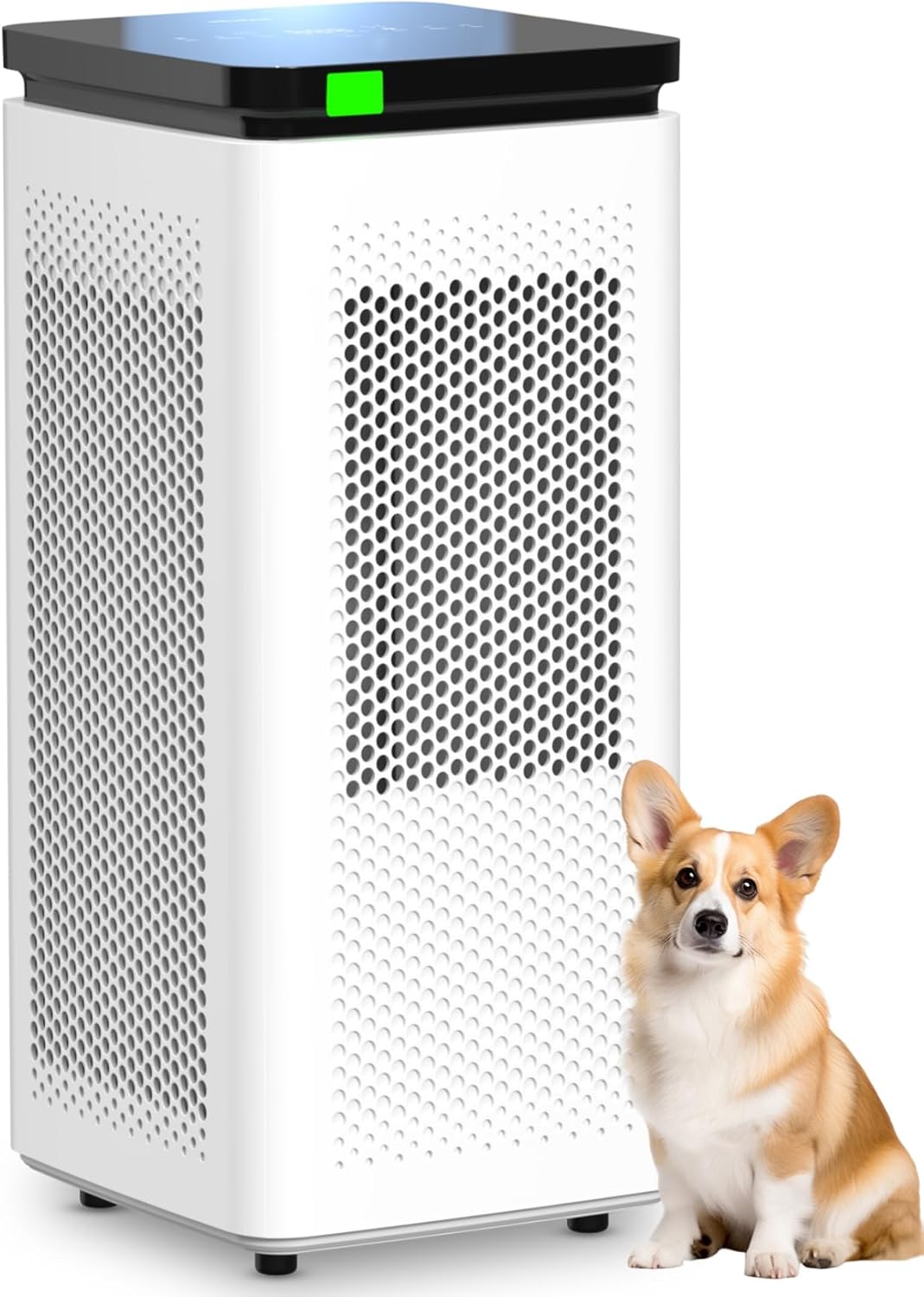
The SIESEAN air purifier is listed with a 235 CFM CADR and dual-sided airflow, stated to cover up to 3,500 sq ft. It uses an H13 True HEPA filter and an activated carbon filter to remove odors and smoke.
It features a sleep mode with a listed 30dB noise level and a panel dimmer. Other features include a smart PM2.5 air quality display, auto mode, a timer, and a child lock. The listing states it is independently tested and certified by CARB, DOE, EPA, and UL.
Best for: This model is suited for large, open-concept spaces due to its high CADR and listed maximum coverage area.
Pros
- High 235 CFM CADR for large rooms
- Quiet 30dB sleep mode
- Digital PM2.5 display and auto mode
- Includes child lock and timer
Cons
- Large physical footprint for placement
- The listing does not mention AHAM verification
3. Best with 360-degree filtration: Clorox Large Room Air Purifier
The Clorox Large Room Air Purifier uses a 3-stage 360° filter system with a True HEPA filter, a pre-filter, and an active carbon filter. The True HEPA filter is listed to capture 99.97% of particles as small as 0.1 microns.
It uses 360-degree airflow and is listed as suitable for rooms up to 1,500 sq ft. It has a programmable timer and a filter replacement indicator light. The listed noise level is 30 dB, and it has a touch control panel.
Best for: This is a good option for those who want a multi-directional air intake and a familiar brand name.
Pros
- 360-degree air intake design
- Filter replacement indicator
- Listed as Certified HEPA
- Quiet 30 dB operation
Cons
- The listing does not mention an auto mode or air quality sensor
- Requires filter replacement every 6-12 months
4. Best for quiet bedrooms: FreAire HAP606 Air Purifier
The FreAire HAP606 features a real-time PM2.5 digital display and a color-coded air quality indicator. Its filtration system uses a 3-layer H13 HEPA filter stated to capture 99.97% of particles down to 0.3 microns.
It has a 360° air intake and is listed to refresh air in rooms up to 1,800 sq ft every 15 minutes. Key features include a sleep mode with a listed 20dB noise level, child lock, timer, and auto mode.
Best for: This model is ideal for bedrooms and nurseries where a very quiet 20dB sleep mode is a priority.
Pros
- Very quiet 20dB sleep mode
- Real-time PM2.5 digital display
- Includes child lock and timer
- 360-degree air intake
Cons
- The listing does not mention CADR or AHAM verification
- Requires use of official brand filters for stated performance
5. Best with large touch display: ECOSELF HAP602 Air Purifier
The ECOSELF HAP602 air purifier has a built-in PM2.5 sensor and a real-time air quality display that changes color. It uses a 3-stage advanced filtration system.
The listing states it can refresh the air in a space up to 2,400 sq ft every 30 minutes. It offers three fan speeds, an automatic mode, a child lock, and a sleep mode listed at 20dB. The control panel is a large touch display.
Best for: This pick is for those who want a clear, color-coded air quality readout on a large display.
Pros
- Large touch display with real-time PM2.5 feedback
- Ultra-quiet 20dB sleep mode
- Automatic mode adjusts fan speed
- Includes child lock
Cons
- The listing does not mention the filter’s HEPA class or certification
- Filter needs replacement every 3 to 6 months
Air purifier picks at a glance
| Model | True HEPA Filter | Listed Max Coverage | Key Feature | Sleep Mode Noise |
|---|---|---|---|---|
| Winix 5520 | Yes (99.99% at 0.01μm) | 1,882 sq ft (1 hr) | AHAM-verified, Auto Mode | Not listed |
| SIESEAN AP-400 | Yes (H13, 99.97%) | 3,500 sq ft | 235 CFM CADR, Dual Airflow | 30 dB |
| Clorox 11010 | Yes (99.97% at 0.1μm) | 1,500 sq ft | 360° Filtration | 30 dB |
| FreAire HAP606 | Yes (H13, 99.97%) | 1,800 sq ft | 20dB Sleep, PM2.5 Display | 20 dB |
| ECOSELF HAP602 | Yes (3-stage) | 2,400 sq ft (30 min) | Large Touch Display | 20 dB |
How to choose the best HEPA air purifier
Selecting the best HEPA air purifier starts with understanding your room size. Look for the Clean Air Delivery Rate (CADR) or a listed room coverage. A higher CADR means the purifier can clean the air in a larger room more quickly. For more on this metric, read our Air Purifier CADR Explained guide. Ensure the unit uses a True HEPA filter, which is the standard for removing fine particles.
Consider how you’ll use it. For bedrooms, a quiet sleep mode (often listed in decibels) is essential. For living areas with pets or cooking, an activated carbon filter helps with odors. Smart features like auto mode and air quality sensors can provide hands-off operation, adjusting performance as needed.
What to look for
- True HEPA Filter: The core filter should be labeled True or HEPA, capturing 99.97% of particles 0.3 microns in size.
- Room Size Match: Choose a model with a listed coverage area or CADR that meets or exceeds your room’s square footage.
- Noise Level: Check the listed decibel level for sleep mode if using in a bedroom.
- Additional Features: Consider auto mode, filter indicators, child locks, and carbon filters based on your household’s needs.
Finally, factor in ongoing costs. Most HEPA filters need replacement every 6 to 12 months. Check the availability of genuine replacement filters for your chosen model to ensure easy maintenance.
FAQ
What is a True HEPA filter?
A True HEPA filter is a type of pleated mechanical air filter that must meet a specific standard, capturing 99.97% of particles that are 0.3 microns in size. This includes common allergens like dust, pollen, mold spores, and pet dander. The term “True” is often used to distinguish these filters from “HEPA-type” or “HEPA-style” filters, which may not meet the same rigorous standard.
How do I know what size air purifier I need?
Match the air purifier’s capacity to your room size. Look for the Clean Air Delivery Rate (CADR) or the manufacturer’s listed maximum room coverage in square feet. For the most accurate sizing, choose a model with an AHAM-verified CADR, which is tested independently. A purifier too small for your space will not effectively clean the air.
Are air purifiers with ionizers or UV lights safe?
Some air purifiers include additional technologies like ionizers or UV-C lights. It’s important to review manufacturer information carefully. Some ionizers can produce ozone, a lung irritant. We recommend checking with sources like the California Air Resources Board for information on ozone-safe devices. Always follow the manufacturer’s manual for safe operation.
How often do I need to replace the HEPA filter?
Replacement frequency varies by model and usage but is typically every 6 to 12 months. Most air purifiers have a filter replacement indicator light. Using the manufacturer’s recommended genuine replacement filter ensures the unit continues to perform as specified.
References
- Amazon product listings and manufacturer specifications (accessed October 2026)
- AHAM (Association of Home Appliance Manufacturers)
- California Air Resources Board: Air Cleaners and Ozone
- Air Cleaners Guide: Air Purifier CADR Explained
- Air Cleaners Guide: Air Purifier Buying Guide