
 By Graham Fisher
Updated November 2026
Home air quality monitoring is easier to get right when you know what a device measures, how it reports results and whether it fits the room you want to watch. The picks below were chosen by comparing product listings, brand track records and patterns in owner feedback, with a focus on the sensors included, the data a unit shows you and how practical it is for everyday indoor use. We did not test these devices ourselves.
Our top picks at a glance
- 1
 TOP CHOICEBest overallReal-Time PM2.5, CO2, TVOC & PM10 Monitor with AlertsView on Amazon
- 2
 Best for multi-room comparisonPM0.3/PM2.5/PM10/CO2/CO/HCHO/TVOC Multi-Parameter Color Display MonitorView on Amazon
- 3
 Best for data loggingProfessional 18-in-1 Air Quality Monitor with TF Card LoggingView on Amazon
Our Top Picks
Quick Comparison
| Product | Best for | Key feature |
|---|---|---|
| Real-Time PM2.5, CO2, TVOC & PM10 Monitor | Overall home use | Real-time alerts |
| Multi-Parameter Color Display Monitor | Comparing several rooms | Color display, 10 readings |
| Professional 18-in-1 Air Quality Monitor | Tracking trends over time | TF card logging |
Real-Time PM2.5, CO2, TVOC & PM10 Monitor with Alerts
Real-Time PM2.5, CO2, TVOC & PM10 Monitoring with Alerts, Portable Air Quality Sensor for Home, Bedroom, Office & Car Smart CO2 Monitor with WiFi App, 10-in-1 Air Quality Monitor Indoor
Best for: Overall home use with alerts when readings climb.
This portable unit suits people who want one device for a bedroom, office or car and prefer live readings over raw logs. Its alerts make it easy to notice a spike from cooking, candles or poor ventilation.
Pros
- Covers fine particles, CO2 and VOCs in one unit
- WiFi app for checking readings remotely
Cons
- Sensor accuracy can drift, so compare with a known reference occasionally
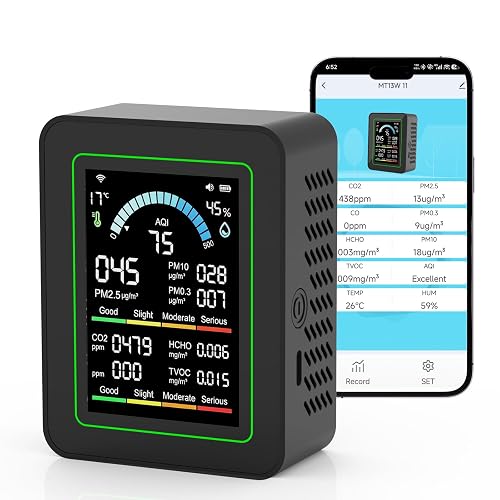
PM0.3/PM2.5/PM10/CO2/CO/HCHO/TVOC Multi-Parameter Color Display Monitor
PM0.3/PM2.5/PM10/CO2/CO/HCHO/TVOC/AQI/Temperature/Humidity Monitoring for Home Office Kitchen New Furniture & Car Air Quality Monitor Indoor, Real-Time Multi-Parameter,Color Display
Best for: Comparing several rooms at a glance.
A color screen and a wide set of readings, including formaldehyde and temperature and humidity, make this a good fit for new furniture, kitchens and home offices where several sources matter.
Pros
- Reports ten parameters, including formaldehyde and AQI
- Color display is easy to read from across a room
Cons
- Many readings can be overwhelming for users who only want a single number
Professional 18-in-1 Air Quality Monitor with TF Card Logging
Built-in 2GB TF card, 5-second logging, screen-off night monitoring, trend graphs, particle comparison and TXT export to PC Professional 18-in-1 Air Quality Monitor,CO2 Monitor,PM2.5,PM10,HCHO,AQI
Best for: Tracking trends over time.
Owners who want to see how air changes overnight or across a week will value the built-in storage and graphing. It suits anyone troubleshooting a recurring problem in a specific room.
Pros
- Built-in 2GB TF card with 5-second logging
- Trend graphs and TXT export to a PC
Cons
- Data review takes more effort than a simple live display
Buying Guide
Choose the Right Sensors
Fine particles (PM2.5) matter most for smoke and dust, while CO2 indicates how well a room is ventilated. Check that the pollutants you care about are actually listed in the specifications.
Check Logging and Alerts
If you want to investigate patterns, look for storage and export options. If you only need a warning, live alerts may be enough.
Consider Display and Portability
A readable screen helps in bedrooms and kitchens, while a compact unit is easier to move between rooms or take into a car.
Good picks for this: Real-Time PM2.5, CO2, TVOC & PM10 Monitor and Professional 18-in-1 Air Quality Monitor
FAQ
Do home air quality monitors replace professional testing?
No. Consumer monitors show trends and flag spikes, but they are not a substitute for certified laboratory testing when you need precise results. For health or safety concerns, consult a qualified professional.
How often should I check my readings?
Checking during cooking, cleaning, and in the morning and evening gives a useful picture. Logging devices can capture this automatically.
Where should I place a monitor?
Set it at breathing height, away from windows, vents and direct heat sources, so the readings reflect the room rather than one local source.
Conclusion
For most homes, the overall monitor with real-time alerts is the simplest starting point. Choose the multi-parameter display model if you want to compare several rooms, and the logging unit if you need to track trends over days or weeks.
Sources
- Indoor air quality guidance, pollutant sources and ventilation tips (epa.gov)
- Health effects of indoor air pollutants and when to seek medical advice (cdc.gov)
Related reading
- How Does Monitoring of Air Quality Work at Home? Setup and Tips
- 4 Best Sensors for Air Quality Monitoring at Home (2026)
- What Is Air Quality in Washington DC and How Do You Protect Your Home?
- What Are the Impacts of Air Quality on Health and Home?
About Graham Fisher
Graham Fisher is part of our editorial team and reviews and edits our indoor air guides, checking product details against manufacturer specifications and owner feedback.
