By Ella Sterling
Cat dander is one of the hardest indoor allergens to manage, and an air purifier for cat dander can make a noticeable difference when it is sized and filtered correctly. Dander is made of tiny flakes of skin, saliva proteins that stick to fur and coat surfaces, and fine particles that stay airborne far longer than most people expect. Because those particles are small, a purifier needs a true HEPA filter and enough airflow for the room, not just a fan and a pre-filter. This guide ranks eight well-established models by how well they fit the criteria that matter for cat households: capture efficiency on fine particles, airflow matched to room size, a sealed cabinet that limits bypass, pre-filters that catch fur before it clogs the HEPA layer, and filter costs you will pay over time. Recommendations are based on manufacturer specifications, brand reputation, and patterns in owner feedback. We did not run lab or home tests.
Our Top Picks
Quick Comparison
| Product | Best for | Key feature |
|---|---|---|
| Coway AP-1512HH Mighty | Bedrooms and medium living rooms | Four-stage filtration with a true HEPA layer |
| Levoit Core 300 | Small rooms and budget-minded buyers | Compact footprint and quiet low-speed operation |
| Blueair Blue Pure 211+ | Open-plan spaces with heavy shedding | Particle plus carbon filter in a fabric-wrapped body |
| Honeywell HPA300 | Large rooms with multiple cats | High airflow rating for its class |
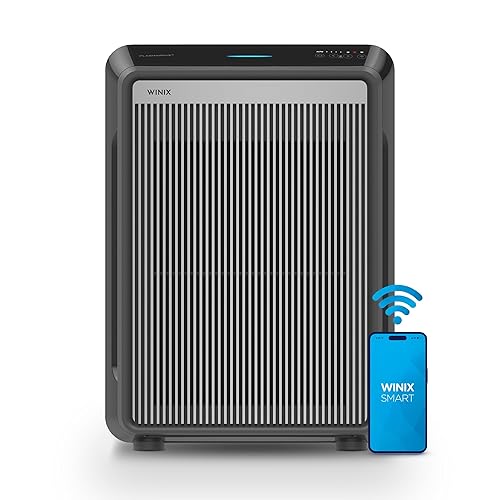
| Winix 5500-2 | Multi-stage filtering with odor control | PlasmaWave technology paired with carbon filtration |
| Dyson Purifier Cool TP07 | Households that want a tower with air circulation | Sealed HEPA system with a built-in fan |
| Rabbit Air MinusA2 | Allergy-focused homes with long run times | Multi-layer HEPA with customizable filter options |
| Coway Airmega 400 | Large open spaces needing fast air changes | High CADR for its footprint |
Coway AP-1512HH Mighty
This model suits cat owners with one or two cats who want reliable HEPA filtration in a bedroom or medium living room. Its layered design captures fur and large debris first, which helps the fine-particle filter last longer.
Key specs
- Filtration: pre-filter, activated carbon, true HEPA, and an optional odor filter
- Rated for rooms up to roughly 350 square feet, per manufacturer guidance
- Three fan speeds plus a sleep mode and air quality indicator
Pros
- Strong performance on fine particles for its room-size rating
- Pre-filter is easy to rinse and reuse
- Quiet on low settings suitable for overnight use
Cons
- Replacement filter sets add up over a year
- Not ideal for very large open-plan rooms
Levoit Core 300
Owners with a single cat in a studio apartment or small bedroom often choose this compact unit. It is a sensible entry point when space and noise matter more than maximum airflow.
Key specs
- Three-stage filtration: pre-filter, True HEPA, and activated carbon
- Designed for rooms up to roughly 219 square feet, per manufacturer specifications
- Auto mode with a particle sensor and sleep setting
Pros
- Small footprint fits nightstands and tight corners
- Low noise on the lowest fan setting
- Straightforward controls with clear filter-change indicators
Cons
- Limited airflow for multi-cat households or large rooms
- Carbon layer is modest, so strong odors may need a separate solution
Blueair Blue Pure 211+
This purifier suits homes where cats shed heavily and fur travels across open floor plans. Its fabric-wrapped pre-filter is designed to catch hair before it reaches the main filter.
Key specs
- Particle filter combined with activated carbon in a single cartridge
- Rated for medium rooms, with manufacturer room-size guidance in the product literature
- Three fan speeds with a quiet operating mode
Pros
- Fabric pre-filter captures fur effectively, according to owner feedback patterns
- Attractive, low-profile design that fits living spaces
- Filter replacement is relatively simple
Cons
- Filter cartridges can be a recurring expense
- Carbon capacity is limited for heavy cooking or litter odors
Honeywell HPA300
Households with two or more cats in a larger room often look at this model for its airflow. It is a practical choice when fast air changes matter more than a slim profile.
Key specs
- True HEPA filter with a pre-filter for larger particles
- Rated for large rooms, per manufacturer specifications
- Multiple fan speeds and a filter-change reminder
Pros
- Strong airflow for its class
- Filters are widely available
- Simple, no-frills controls
Cons
- Bulkier than compact models and louder at high speed
- Lacks a dedicated odor-focused carbon stage in some configurations
Winix 5500-2
This model fits cat owners who also deal with litter box or food odors alongside dander. Its combination of PlasmaWave technology and carbon filtration targets both particles and smells.
Key specs
- Filtration: pre-filter, True HEPA, activated carbon, and PlasmaWave
- Rated for mid-size to large rooms, per manufacturer specifications
- Auto mode with air quality sensing and a sleep setting
Pros
- Multi-stage design handles both particles and odors
- Sensor-driven auto mode adjusts fan speed automatically
- Good coverage for medium-to-large living areas
Cons
- Ozone-related concerns are sometimes raised with ionizing technologies, so review manufacturer ozone statements
- Filter sets add to ongoing costs
Dyson Purifier Cool TP07
Owners who want a tower purifier that also circulates air through a room often consider this model. It works well in open living spaces where a single unit should cover a wide area.
Key specs
- Sealed HEPA filtration with activated carbon
- Built-in fan for air circulation and oscillation
- App and remote control options in supported configurations
Pros
- Sealed filter system limits bypass of unfiltered air
- Circulation helps distribute purified air across open rooms
- Sleek design and touch-friendly controls
Cons
- Premium option with a higher long-term filter cost
- Fur can accumulate on the intake, so regular cleaning is needed
Rabbit Air MinusA2
This purifier suits allergy-prone households that want customizable filtration and long daily run times. Its multi-layer HEPA design is built around capturing very fine particles.
Key specs
- Multi-layer HEPA with optional activated carbon and specialty filters
- Rated for large rooms, per manufacturer specifications
- Quiet operating modes and a sleep setting
Pros
- Filter options can be tailored to specific allergens or odors
- Well-regarded build quality among owners
- Designed for extended daily operation
Cons
- Higher-end pricing and specialized filters can raise ongoing costs
- Larger footprint than compact bedroom models
Coway Airmega 400
This model is often considered by owners with a big open space or a home with several cats. Its high clean air delivery rate for the footprint helps when the goal is fast air changes.
Key specs
- Four-stage filtration including True HEPA and activated carbon
- Rated for large rooms, per manufacturer specifications
- Air quality indicator and auto mode
Pros
- Strong airflow for a relatively compact body
- Auto mode responds to changing particle levels
- Filters are widely stocked
Cons
- Fan noise is noticeable on higher settings
- Filter replacement schedule should be tracked closely in multi-cat homes
Buying Guide
Choosing an air purifier for cat dander is mostly about matching filtration quality and airflow to the room you actually live in. Cat dander particles are fine, sticky, and often carried on fur, so a unit that performs well on paper but moves little air will struggle. Start with the criteria below and narrow your list before comparing features.
Selection criteria
- True HEPA filtration, which manufacturers specify as capturing at least 99.97 percent of particles at 0.3 microns
- Airflow sized to room volume, expressed through CADR (clean air delivery rate) and room-size ratings
- A pre-filter that traps fur and hair before it reaches the HEPA layer
- A sealed or well-fitted cabinet that limits unfiltered air leaking around the filter
- Ongoing filter costs and how often replacements are specified
For a deeper look at how airflow ratings work, see Air Purifier CADR Explained. To estimate what size you need, Air Purifier Room Size Guide walks through the math.
Important features
Activated carbon helps with litter box and food odors but does little for particles, so treat it as a supplement rather than the main event. Auto modes with particle sensors are convenient in homes where cats are active at unpredictable times. A filter-change indicator is worth having because a clogged HEPA filter loses airflow long before it stops working entirely. For a broader primer, How Air Purifiers Work explains the layers in plain terms.
Specs to check
- CADR ratings for smoke, dust, and pollen, which indicate overall particle clearance
- Recommended room size, which should be at least as large as your room
- Noise levels at the speed you plan to run most of the day
- Replacement filter part numbers and typical replacement intervals
Choosing by need
- One cat, small bedroom: a compact HEPA unit with a pre-filter is usually enough.
- Two or more cats, living room: prioritize airflow and a sizable pre-filter.
- Open-plan home with heavy shedding: look at models that circulate air and have washable pre-filters.
- Odors plus dander: choose a unit with a meaningful carbon stage, and consider Best True HEPA Air Purifiers for HEPA-focused options.
If your bedroom is the main concern, Best Air Purifiers for Bedrooms covers units designed for quiet overnight use.
Things to watch out for
- “HEPA-type” or “HEPA-like” labels do not guarantee true HEPA performance, so read the specification carefully.
- Ionizers and ozone-generating features can produce byproducts, so check manufacturer ozone statements.
- Filters are the main recurring expense, and some models use proprietary cartridges.
- Placing a purifier behind furniture or in a corner reduces effectiveness, so position it where air can circulate.
Routine upkeep, including pre-filter cleaning and timely HEPA replacement, is covered in Air Purifier Maintenance. If your cat has asthma or you have a diagnosed allergy, consult an allergist or physician about whether an air purifier should be part of your plan.
FAQ
Does an air purifier actually reduce cat dander?
Yes, a purifier with a true HEPA filter can capture airborne dander particles, which helps lower what you breathe. It will not remove dander already settled on furniture or floors, so regular cleaning remains important.
What size air purifier do I need for cat dander?
Match the unit’s rated room size to your room, and round up if you have multiple cats or a high ceiling. Larger rooms need higher CADR ratings to achieve useful air changes per hour.
Is a HEPA filter enough, or do I need carbon too?
HEPA handles dander and fur particles. Activated carbon helps with odors from litter boxes and food. Many cat owners choose a unit with both.
How often should I replace the filter?
Replacement intervals vary by model and by how many cats share the space. Manufacturers typically specify a timeframe, and filter-change indicators are a useful guide. Heavy shedding can shorten pre-filter cleaning intervals.
Can an air purifier help with cat allergies?
Many allergy sufferers find that purifiers reduce symptoms by lowering airborne allergens. Results vary by person. Consult an allergist for guidance on managing allergies.
Should the purifier run all day?
Running it continuously on a low or auto setting usually works best, because dander is constantly shed. Many owners keep the unit on in the bedroom overnight.
Where should I place the purifier?
Position it in open space at least a few feet from walls and furniture, away from curtains. Keep it where the cat spends time, such as a bedroom or main living area.
Conclusion
For cat owners, the right air purifier for cat dander depends on room size, the number of cats, and whether odors are part of the problem. A compact unit like the Levoit Core 300 suits a single cat in a small room, while the Coway AP-1512HH Mighty and Winix 5500-2 fit medium rooms where odor control matters. Larger spaces and multi-cat homes are better served by the Honeywell HPA300 or Coway Airmega 400. Owners who want circulation in open plans may consider the Dyson Purifier Cool TP07, and those prioritizing customizable HEPA layers may look at the Rabbit Air MinusA2. Check room-size ratings, confirm true HEPA filtration, and budget for filter replacements before you decide.

About Ella Sterling
Ella covers indoor air, comparing specs, features and long-term owner feedback to help readers choose with confidence.