
 By Audrey Hayes
Updated November 2026
If you want to know what you are actually breathing indoors, a sensor for air quality is the most direct tool you can buy. Unlike a purifier, which only acts on the air, a sensor measures pollutants such as fine particles (PM2.5), carbon dioxide, volatile organic compounds (TVOCs), temperature and humidity, and shows you the numbers so you can decide what to do. The four models below were selected by comparing published specifications, brand reputation and the patterns owners tend to report, with attention to which pollutants each device measures, how it displays results, whether it connects to an app and how practical it is for home, office or vehicle use. We have not tested these units ourselves, so treat the picks as a research-based shortlist rather than hands-on verdicts.
Our top picks at a glance
- 1
 TOP CHOICEBest overallGoveeLife Smart Air Quality Monitor with PM2.5 H5106View on Amazon
- 2
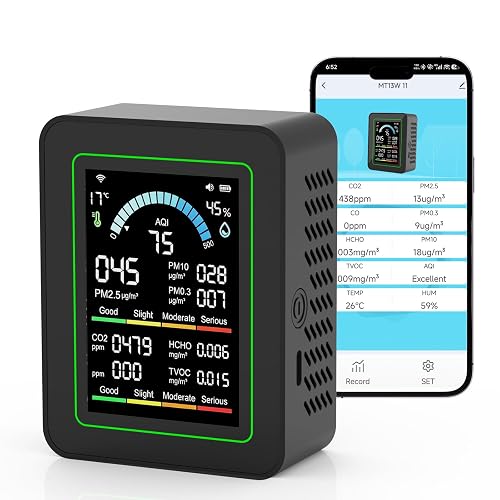 Best for multi-pollutant tracking10-in-1 Air Quality Monitor Indoor (PM2.5, CO2, TVOC, PM10)View on Amazon
- 3
 Best for whole-house data loggingDavis Instruments AirLink Professional Air Quality SensorView on Amazon
- 4
 Best budget pickGM Genuine Parts 23262343 Multi-Purpose Air SensorView on Amazon
Our Top Picks
| Product | Best for | Key feature |
|---|---|---|
| GoveeLife Smart Air Quality Monitor with PM2.5 H5106 | Everyday home monitoring | PM2.5, temperature and humidity with a wired LED display |
| 10-in-1 Air Quality Monitor Indoor (PM2.5, CO2, TVOC, PM10) | Tracking several pollutants at once | Real-time alerts through a WiFi app |
| Davis Instruments AirLink Professional Air Quality Sensor | Detailed indoor and outdoor data | Air Quality Index plus dew point and heat index |
| GM Genuine Parts 23262343 Multi-Purpose Air Sensor | Simple, low-commitment monitoring | Multi-purpose air sensor for basic readings |
GoveeLife Smart Air Quality Monitor with PM2.5 H5106
Indoor temperature humidity sensors, 2s refresh, 2-year data storage, for home & office, 2.4G Wi-Fi only GoveeLife Smart Air Quality Monitor with PM2.5 H5106, LED Display Wired
Best for: Everyday home monitoring with a clear, always-visible readout
This is a good fit for households that want a sensor in a main living area or bedroom and a quick glance at conditions without setting up an app. The listing describes it as an indoor temperature and humidity sensor with a 2-second refresh rate, 2-year data storage and a 2.4G Wi-Fi connection, with PM2.5 measurement and a wired LED display.
Key specs:
- Measures PM2.5 particulate matter, temperature and humidity
- 2-second refresh rate, per the listing
- 2-year data storage, per the listing
- 2.4G Wi-Fi only (5G networks are not supported)
- Wired LED display
Pros:
- Shows readings on the unit itself, so no phone is needed for a quick check
- Combines particle and climate readings in one device
- Fast refresh makes it easy to watch conditions change after cooking or cleaning
Cons:
- Wi-Fi is limited to 2.4 GHz, which can be a setup obstacle on dual-band routers
- Covers fewer pollutant types than multi-sensor units
Bottom line: A sensible first monitor for someone who mainly wants to know whether particle levels and humidity are in a healthy range at home.
10-in-1 Air Quality Monitor Indoor (PM2.5, CO2, TVOC, PM10)
Real-Time PM2.5, CO2, TVOC & PM10 Monitoring with Alerts, Portable Air Quality Sensor for Home, Bedroom, Office & Car Smart CO2 Monitor with WiFi App, 10-in-1 Air Quality Monitor Indoor
Best for: Tracking several pollutants at once with alerts
This suits people who want a broader picture, such as a parent watching CO2 in a child’s bedroom or someone concerned about volatile organic compounds from new furniture or cleaning products. Its listing emphasizes real-time monitoring, alerts and portability for home, office or car use.
Key specs:
- Monitors PM2.5, PM10, CO2 and TVOC, per the listing name
- WiFi app connectivity with real-time alerts
- Portable design for home, office or vehicle use
Pros:
- Covers more pollutant types than single-sensor monitors
- App alerts help you act when a threshold is crossed
- Portable enough to move between rooms
Cons:
- Relies on a phone app for the full feature set, which some users dislike
- Sensors of this type generally need periodic calibration or replacement to stay accurate, so check the manufacturer’s care guidance
Bottom line: Best for buyers who want more than particle counts and are comfortable managing readings through an app.
Davis Instruments AirLink Professional Air Quality Sensor
Davis Instruments AirLink Professional Air Quality Sensor for Indoor or Outdoor use. Provides Air Quality Index, Temperature, Humidity, Dew Point, Heat Index
Best for: Detailed indoor and outdoor data for people who want a more technical instrument
This is aimed at users who want Air Quality Index readings alongside weather-style data such as dew point and heat index. Its indoor-or-outdoor design makes it useful for comparing conditions inside and outside the home, and it fits well into a broader monitoring setup.
Key specs:
- Provides Air Quality Index, temperature, humidity, dew point and heat index, per the listing
- Usable indoors or outdoors
Pros:
- Professional-style instrument with an Air Quality Index output
- Dew point and heat index add useful context for humidity-related mold risk
- Works for indoor and outdoor comparison
Cons:
- More complex than a basic home monitor, which may be more than a casual user needs
- Outdoor use requires attention to placement and weather exposure
Bottom line: Suited to users who want technical data and comparisons between indoor and outdoor air rather than a simple status light.
GM Genuine Parts 23262343 Multi-Purpose Air Sensor
GM Genuine Parts 23262343 Multi-Purpose Air Sensor
Best for: Simple, low-commitment monitoring with a budget-friendly approach
This is a practical option for someone who wants a basic air sensor without a feature-heavy app or dashboard. Owners generally use this type of unit as a supplemental check rather than a complete monitoring system.
Key specs:
- Multi-purpose air sensor, per the listing name
- Specifications beyond the listing name should be confirmed on the product page
Pros:
- Straightforward purpose with minimal setup
- Good as a second or spot-check sensor
- Budget-friendly style of buy
Cons:
- Fewer features and less documented detail than the multi-pollutant models
- Limited suitability for detailed pollutant tracking
Bottom line: A reasonable choice for a simple check on air conditions, but not the best pick for someone who needs comprehensive data.
Buying Guide
Pollutants measured
Start with what you want to know. PM2.5 tracks fine particles from smoke, cooking and dust. CO2 is a useful proxy for ventilation in occupied rooms. TVOC readings flag many household chemicals. Match the sensor to the pollutants relevant to your home rather than buying the most sensors you can find.
Good picks for this: 10-in-1 Air Quality Monitor Indoor and GoveeLife Smart Air Quality Monitor with PM2.5 H5106
Display and readability
Some monitors show readings on a built-in screen, while others rely on a phone app. A wired LED display is convenient in a shared room, while an app suits people who check data on their phones. Consider which method you will actually use every day.
Good picks for this: GoveeLife Smart Air Quality Monitor with PM2.5 H5106 and 10-in-1 Air Quality Monitor Indoor
Connectivity
Check the Wi-Fi standard before buying. Many devices support only 2.4 GHz networks. If your router broadcasts a separate 5 GHz network, confirm that the sensor connects to the 2.4 GHz band during setup.
Good picks for this: 10-in-1 Air Quality Monitor Indoor and GoveeLife Smart Air Quality Monitor with PM2.5 H5106
Placement and use case
Where you place the sensor matters as much as the device itself. Keep it away from direct sunlight, vents, cooking appliances and humidifiers, which can skew readings. Place it at breathing height in the room you want to measure. Portable models suit multiple rooms, while fixed units suit one spot.
Good picks for this: Davis Instruments AirLink Professional Air Quality Sensor and 10-in-1 Air Quality Monitor Indoor
Durability and sensor life
Particle and gas sensors have a limited working life and can drift over time. Look for manufacturer guidance on expected lifespan, recalibration and sensor replacement. Keeping the intake clear of dust extends performance.
Good picks for this: Davis Instruments AirLink Professional Air Quality Sensor and GM Genuine Parts 23262343 Multi-Purpose Air Sensor
Data storage and history
If you want to spot patterns, such as particle spikes at certain times of day, choose a device with data logging. Confirm how long readings are stored and whether you can export them. A history view is far more useful for finding causes than a single live number.
Good picks for this: GoveeLife Smart Air Quality Monitor with PM2.5 H5106 and Davis Instruments AirLink Professional Air Quality Sensor
Budget and value
A basic sensor is enough for a spot check, while multi-pollutant monitors cost more to own and may need replacement parts over time. Think about total ownership, including any replacement sensors or subscription features, before deciding.
Good picks for this: GM Genuine Parts 23262343 Multi-Purpose Air Sensor and 10-in-1 Air Quality Monitor Indoor
FAQ
What is a sensor for air quality and what does it measure?
It is a device that detects pollutants and conditions in the air and reports them as readings. Common measurements include PM2.5 and PM10 particles, CO2, volatile organic compounds and humidity or temperature. Readings show the presence and rough level of each pollutant, not a medical diagnosis.
Is a sensor better than an air purifier?
They do different jobs. A sensor tells you what is in the air, while a purifier removes some particles. A sensor helps you decide whether a purifier is needed and whether it is working in your space.
Where should I place an indoor air quality sensor?
Place it at about breathing height, away from windows, vents, cooking areas and humidifiers. Keep it in the room where you spend the most time, such as a bedroom or living room.
How often do air quality sensors need to be replaced or calibrated?
Timing depends on the sensor type and manufacturer. Check the product documentation for expected sensor life, recalibration steps and replacement schedules, since these vary widely.
Do I need Wi-Fi for an air quality sensor?
Not always. Some monitors show readings on a built-in display, which works without a network. Wi-Fi is needed for app alerts, remote viewing and data history, so decide whether those features matter to you.
Can an air quality sensor tell me if my air is safe to breathe?
A sensor gives measurements, but it cannot determine health risk on its own. If you have respiratory conditions, allergies, or concerns about specific exposures such as mold, carbon monoxide or radon, consult a qualified professional, such as a physician, industrial hygienist or certified inspector.
Are cheap air quality sensors accurate?
Accuracy varies by model and sensor technology. Consumer sensors are useful for tracking trends and comparing conditions, but they are generally less precise than reference-grade instruments. Use them to spot changes rather than to certify exact concentrations.
Conclusion
For most households, the GoveeLife Smart Air Quality Monitor with PM2.5 H5106 is the most straightforward starting point, since it displays readings clearly and covers particles and climate. If you want to track several pollutants and receive alerts, the 10-in-1 Air Quality Monitor Indoor fits that need. The Davis Instruments AirLink Professional Air Quality Sensor suits people who want technical, indoor-and-outdoor data. The GM Genuine Parts 23262343 Multi-Purpose Air Sensor is the simplest option for occasional spot checks. Whichever you choose, place it thoughtfully and read the manufacturer’s guidance on maintenance.
Sources
- Indoor air quality basics, pollutant sources and home ventilation guidance (epa.gov)
- Consumer safety information on indoor air hazards and product recalls (cpsc.gov)
- Guidance on home ventilation, moisture control and indoor environmental quality (energy.gov)
Related reading
- Testing for Indoor Air Quality: A Step-by-Step Guide for Homeowners
- Test for Air Quality in House: A Step-by-Step Guide for Homeowners (2026)
- Snake Plant for Air Quality: What It Does and How to Use It
- Reno Nevada Air Quality: How to Check, Read and Protect Your Home
About Audrey Hayes
Audrey Hayes is part of our editorial team and reviews and edits our indoor air guides, checking product details against manufacturer specifications and owner feedback.
