 By Audrey Hayes
Updated November 2026
Finding the best air quality in United States homes starts with knowing what you are measuring and what you can change. Most people shopping for this want a way to see what is in their air, and then a way to improve it. This list covers both sides: two air purifiers with particle sensors, a whole-home style monitor for radon and volatile organic compounds, and an outdoor monitor for tracking what drifts in from outside. The selection criteria were specifications, brand reputation, and the patterns owners commonly report about accuracy, noise, filter upkeep and ease of setup. We did not run these units ourselves, so treat the notes below as a research summary rather than hands-on results.
Our top picks at a glance
- 1
 TOP CHOICEBest overallAmazon Smart Air Quality MonitorView on Amazon
- 2
 TOP CHOICEBest for large open roomsSmart Mode HAP603 PM2.5 Air PurifierView on Amazon
- 3
 TOP CHOICEBest budget pickAROEVE AP04 Air Purifier with Air Quality SensorsView on Amazon
- 4
 Best for radon and VOC monitoringAirthings 2960 View PlusView on Amazon
- 5
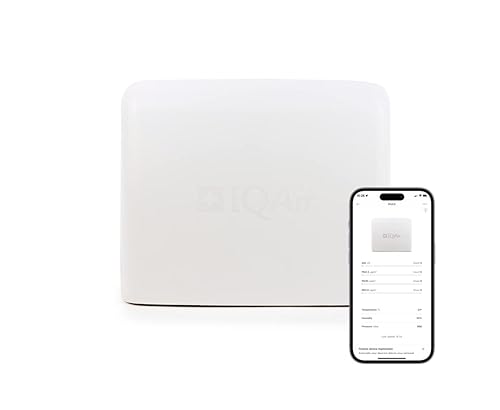 Best for outdoor air trackingAirVisual Outdoor Air Quality MonitorView on Amazon
Our Top Picks
Quick Comparison
| Product | Best for | Key feature |
|---|---|---|
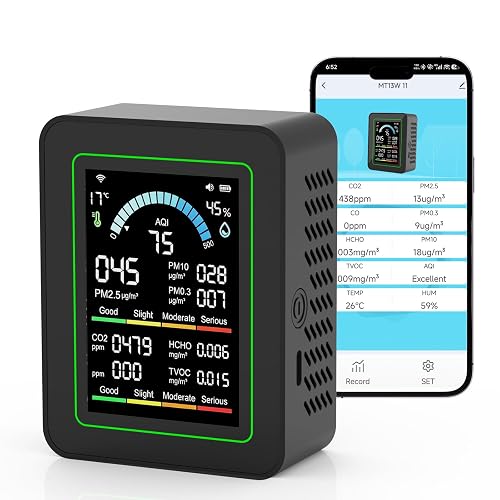
| Amazon Smart Air Quality Monitor | Whole-home awareness with alerts | Tracks temperature, humidity, CO, PM2.5 and VOCs |
| Smart Mode HAP603 Air Purifier | Large open rooms | True HEPA filter rated up to 2400 sq ft |
| AROEVE AP04 Air Purifier | Budget-conscious buyers | Built-in air quality sensors with auto mode |
| Airthings 2960 View Plus | Radon and VOC monitoring | Battery-powered radon and multi-pollutant sensing |
| AirVisual Outdoor | Tracking outdoor pollution | PM1, PM2.5 and PM10 readings with Wi-Fi |
Amazon Smart Air Quality Monitor
Amazon Smart Air Quality Monitor, Detects temperature, humidity, carbon monoxide, PM2.5 and VOCs, Get notifications when air quality drops, Works with Alexa
Best for: Whole-home awareness with alerts
This suits households that want a constant read on conditions without running a purifier. It is a good first step if you do not yet know which pollutant is the problem.
Key specs
- Detects temperature, humidity, carbon monoxide, PM2.5 and VOCs
- Sends notifications when air quality drops
- Works with Alexa
Pros
- Covers several pollutant types in one device
- Alerts help you act before symptoms appear
- Voice integration makes readings easy to check
Cons
- A monitor does not clean the air by itself
- Sensor readings are best used for trends rather than lab-grade precision
Bottom line: Choose this if you want information first and plan to decide on filtration afterward.
Smart Mode HAP603 PM2.5 Air Purifier
Smart Mode, PM2.5 Air Quality Display, 22dB Sleep Mode, Aromatherapy with 2X-Purification, HAP603, White Air Purifiers for Home Large Room, Up to 2400 Ft² with True HEPA Filter
Best for: Large open rooms
Aimed at living rooms, open kitchens and combined spaces where a small purifier would need to run constantly to keep up.
Key specs
- True HEPA filter
- Coverage listed up to 2400 sq ft
- PM2.5 display and sleep mode rated at 22 dB
Pros
- Large listed coverage area
- Real-time PM2.5 display
- Quiet sleep setting for bedrooms
Cons
- Coverage figures assume standard ceiling heights and air changes per hour
- Owners often mention filter replacement costs add up over time
Bottom line: A strong fit for larger single rooms or open-plan floors that need more capacity than a compact unit provides.
AROEVE AP04 Air Purifier with Air Quality Sensors
UV Secondary Purification, Air Quality Monitoring, Auto Mode, 0.3 Microns Filtration Efficiency, 1095 ft² Coverage Area AROEVE Air Purifiers for Home with Air Quality Sensors and Auto-AP04(White)
Best for: Budget-conscious buyers
A practical choice for bedrooms and mid-size rooms where you want automatic adjustment without paying for premium features.
Key specs
- Listed coverage area of 1095 sq ft
- 0.3 micron filtration efficiency
- UV secondary purification and auto mode
Pros
- Auto mode responds to sensed air quality
- Covers mid-size rooms well
- Includes a UV stage as added support
Cons
- UV stages are a supplement, not a substitute for a HEPA filter
- Sensor accuracy varies across the budget category
Bottom line: Pick this if you want sensor-driven automation at a modest level of spending and your room is under about 1100 square feet.
Airthings 2960 View Plus
Airthings 2960 View Plus – Battery Powered Radon & Air Quality Monitor (PM, CO2, VOC, Humidity, Temp, Pressure)
Best for: Radon and VOC monitoring
Useful for basements, ground-floor rooms and homes where radon is a concern, since radon is a gas that standard particle sensors do not detect.
Key specs
- Battery powered
- Measures radon, PM, CO2, VOCs, humidity, temperature and pressure
Pros
- Covers radon, which many monitors skip
- Battery operation allows placement anywhere
- Broad set of pollutant readings
Cons
- Radon readings need time to stabilize, so early numbers can look erratic
- It monitors but does not filter the air
Bottom line: The right pick if radon is a real concern for your home. Follow up with a radon test professional if readings are elevated.
AirVisual Outdoor Air Quality Monitor
AirVisual Outdoor – Outdoor Air Quality Monitor, Detects PM1, PM2.5, PM10, Optional CO2, Temperature, Humidity, Pressure, Modular Sensor Design, Wi-Fi, LAN, German Made
Best for: Tracking outdoor pollution
Designed to sit outside and report particulate levels, which helps you decide when to open windows or run ventilation.
Key specs
- Detects PM1, PM2.5 and PM10
- Optional CO2, temperature, humidity and pressure modules
- Wi-Fi and LAN connectivity
Pros
- Modular sensor design lets you add readings later
- Connects to your network for remote checks
- Helpful for reading outdoor conditions before ventilating
Cons
- Needs an outdoor power source and weather placement
- Monitors outdoor air only, so it will not reflect what is inside your home
Bottom line: A good companion to an indoor monitor if you want to compare what comes in from outside against what stays inside.
Buying Guide
Decide whether you need to measure, filter or both
Monitors report on conditions; purifiers change them. If you are unsure what is in your air, start with a monitor. If you already know the problem, such as smoke, dust or allergens, a purifier with a HEPA filter is usually the more direct tool. Many households end up using both.
Good picks for this: Amazon Smart Air Quality Monitor, Smart Mode HAP603 Air Purifier
Check the pollutants a device actually detects
Particle sensors (PM2.5, PM10) do not detect gases. Radon, carbon monoxide and most VOCs require different sensors. Read the spec list and match it to your concerns before buying.
Good picks for this: Airthings 2960 View Plus, Amazon Smart Air Quality Monitor
Match coverage to the room size
Coverage ratings usually assume a set number of air changes per hour. For a purifier, a rough rule is to choose a unit rated for at least your room’s square footage, and more if you have high ceilings or want faster cleaning during cooking or wildfire smoke.
Good picks for this: Smart Mode HAP603 Air Purifier, AROEVE AP04 Air Purifier
Look for a true HEPA filter
True HEPA filters are rated to capture at least 99.97 percent of particles at 0.3 microns under standardized testing. Products labeled only as “HEPA-type” or “HEPA-like” may perform differently, so read the wording carefully.
Good picks for this: Smart Mode HAP603 Air Purifier, AROEVE AP04 Air Purifier
Plan for filter replacement
Filter life depends on use, air quality and fan speed. Check how often the manufacturer recommends replacing the filter and what the replacement schedule costs you over a year. Owners often mention this as the largest ongoing expense.
Good picks for this: Smart Mode HAP603 Air Purifier, AROEVE AP04 Air Purifier
Consider noise and sleep settings
If the device will run in a bedroom, look for a low sleep-mode decibel rating and a dimmable or off-able display. Noise matters more than most buyers expect once the device runs overnight.
Good picks for this: Smart Mode HAP603 Air Purifier, AROEVE AP04 Air Purifier
Think about placement and connectivity
Outdoor monitors need weather protection and a power source. Indoor monitors work best away from direct sunlight, cooking vapors and heating vents. Wi-Fi or app connectivity helps when you want to check readings remotely.
Good picks for this: AirVisual Outdoor Air Quality Monitor, Airthings 2960 View Plus
FAQ
What does “best air quality” mean for a home?
It means keeping levels of particles, gases and humidity within ranges recommended by health agencies. The right target depends on your household, including children, older adults and anyone with asthma or allergies.
Do I need a monitor and a purifier?
Not always. A monitor tells you what is happening. A purifier changes the air. Many people start with a monitor and add a purifier only if readings show a persistent problem.
Can a particle sensor detect radon?
No. Radon is a gas and requires a dedicated sensor or a radon test kit. Radon levels should be confirmed with a qualified radon professional if your readings are high.
How often should I replace a HEPA filter?
Follow the manufacturer’s schedule. Replacement timing depends on how many hours the unit runs and the air quality where it sits. Visible dust buildup or reduced airflow are signs it may be time.
Are outdoor air quality monitors useful indoors?
They measure outdoor conditions only. Use them to decide when ventilation is safe, but rely on an indoor monitor to see what is happening inside.
Is UV light a substitute for a HEPA filter?
No. UV stages can complement a filter, but they do not capture particles the way a HEPA filter does. Treat UV as a supplement.
When should I talk to a professional?
If you have persistent symptoms, high radon readings, carbon monoxide alarms or signs of mold, consult a qualified professional such as a physician, radon mitigator or licensed inspector.
Conclusion
For most households looking for the best air quality in United States homes, the most useful first step is a monitor, and the Amazon Smart Air Quality Monitor offers broad coverage with alerts. If you need filtration for a larger room, the Smart Mode HAP603 is built for more space, while the AROEVE AP04 suits smaller budgets and mid-size rooms. Homes with radon concerns should look at the Airthings 2960 View Plus, and anyone tracking pollution coming in from outside should consider the AirVisual Outdoor. Match the product to your main concern rather than the longest feature list.
Sources
- Indoor air quality basics, pollutant guidance and home ventilation recommendations (epa.gov)
- Health effects of indoor and outdoor air pollution and who is most at risk (cdc.gov)
- Guidance on home ventilation, filtration and indoor air quality improvements (energy.gov)
Related reading
- Air Quality Map United States: How to Read It and Use It at Home
- Best Indoor Air Quality Monitors
- New York State Air Quality: Why It Dips and How to Protect Your Home
- Best Office Plants Air Quality: Which Plants Help and How to Use Them
- 7 Best Air Purifiers for Poor Air Quality (2026)
- 7 Best Air Purifiers for Indoor Air Quality in 2026: Our Picks Compared
- 7 Best Air Purifiers for Bad Air Quality (2026)
About Audrey Hayes
Audrey Hayes is part of our editorial team and reviews and edits our indoor air guides, checking product details against manufacturer specifications and owner feedback.