As an Amazon Associate I earn from qualifying purchases. This page may contain affiliate links.
Cigar smoke is harder on indoor air than most people expect. Its fine particles are small enough to stay suspended for hours, and the heavier odor compounds cling to fabric, drapes and upholstery long after the smoke itself has cleared. An air purifier for cigar smoke needs two things working together: a true HEPA stage to capture the particles and a meaningful amount of activated carbon to absorb the gases and smell. In this guide we compare eight models based on manufacturer specifications, brand reputation and the patterns owners commonly describe, with the selection criteria explained so you can judge them against your own room.
Our Top Picks
Quick Comparison
| Product | Best for | Key feature |
|---|---|---|
| Coway AP-1512HH Mighty | Medium to large rooms with regular smoking | Four-stage filtration with a substantial activated carbon layer |
| Blueair Blue Pure 211+ | Living rooms and bedrooms with light to moderate smoke | Particle and carbon filter combined in one cartridge |
| Levoit Core 300 | Small rooms and budget-conscious buyers | Compact true HEPA design with a carbon pre-filter |
| Winix 5500-2 | Mid-size rooms needing odor control | PlasmaWave technology paired with carbon filtration |
| Honeywell HPA300 | Large open-plan spaces | High airflow rated for large rooms |
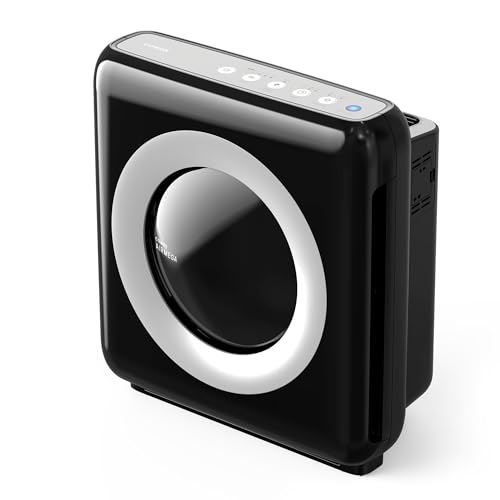
| Coway Airmega 400 | Large rooms with heavy, frequent smoke | Greater airflow capacity with a deep carbon filter |
| Levoit LV-H132 | Bedrooms and smaller seating areas | Quiet operation on low speeds with HEPA filtration |
| Hamilton Beach TrueAir | Small to medium rooms, simple controls | Multi-stage HEPA and carbon filtration in a slim frame |
Coway AP-1512HH Mighty
This is a strong fit for a den, lounge or home office where cigars are smoked regularly and the room is medium to large. Its layered filtration is built around odor as much as particles, which matters for smoke.
Key specs
- Filtration: pre-filter, true HEPA, activated carbon and deodorization stages
- Rated for rooms up to roughly 361 square feet (manufacturer figure)
- Multiple fan speeds with a sleep mode
Pros
- Carbon stage is substantial, which helps with lingering cigar odor
- Covers a larger room than most compact units
- Filter change indicator simplifies maintenance
Cons
- Replacement filters add ongoing cost over time
- Higher speeds are noticeable in a quiet room
Blueair Blue Pure 211+
Suited to living rooms and bedrooms where smoke is occasional rather than constant. Owners often describe it as unobtrusive, which helps when it runs for long stretches.
Key specs
- Filtration: pre-filter plus a combined particle and activated carbon filter
- Designed for rooms of roughly 540 square feet (manufacturer figure)
- Fabric pre-filter option for capturing larger debris
Pros
- Compact footprint that fits beside furniture
- Combined filter simplifies replacement
- Runs quietly on lower settings
Cons
- Carbon capacity is modest for very heavy smoking
- Filter cost accumulates over the unit’s life
Levoit Core 300
A practical choice for a smaller room, such as a single bedroom or a study, where budget matters and the smoke load is light. It is one of the more affordable routes to a true HEPA stage.
Key specs
- Filtration: pre-filter, true HEPA and activated carbon
- Rated for rooms up to roughly 219 square feet (manufacturer figure)
- Three fan speeds plus auto mode
Pros
- Budget-friendly entry point with real HEPA filtration
- Small footprint suits tight spaces
- Simple controls and filter reminder
Cons
- Carbon layer is thinner than premium models, so heavy odor may persist
- Not suited to large or open-plan rooms
Winix 5500-2
Good for a mid-size room where odor is the main complaint. Its PlasmaWave technology is intended to help neutralize particles, and the carbon filter is aimed at smell.
Key specs
- Filtration: True HEPA, activated carbon and PlasmaWave technology
- Rated for rooms up to roughly 360 square feet (manufacturer figure)
- Auto mode with air quality sensor
Pros
- Sensor-based auto mode adjusts to smoke levels
- Carbon filter targets odor effectively for its class
- Covers a useful mid-size area
Cons
- Some owners prefer to disable ionizing functions and rely on filtration alone
- Filter replacements are recurring expenses
Honeywell HPA300
Best for large open-plan spaces where smoke spreads across a wide area. Its airflow rating is the main reason to consider it over smaller units.
Key specs
- Filtration: pre-filter, True HEPA and activated carbon
- Rated for rooms up to roughly 465 square feet (manufacturer figure)
- Multiple speeds with filter change indicator
Pros
- Strong airflow for larger rooms
- Straightforward controls
- Filter status indicator aids maintenance
Cons
- Larger body takes up more floor space
- Higher speeds can be audible during long sessions
Coway Airmega 400
A good match for a large room with frequent, heavy smoke, such as a lounge used for regular cigar nights. The deeper carbon filter is what sets it apart for odor.
Key specs
- Filtration: pre-filter, true HEPA, activated carbon and deodorization stages
- Rated for rooms up to roughly 1,560 square feet (manufacturer figure)
- Smart sensor with auto mode and filter indicator
Pros
- High airflow and large coverage area
- Substantial carbon layer for persistent odor
- Sensor responds to changing smoke levels
Cons
- Significant size and weight make it hard to move
- Replacement filter sets are a long-term expense
Levoit LV-H132
Aimed at bedrooms and smaller seating areas where quiet operation matters, especially overnight. It suits someone who smokes cigars occasionally and wants gentle, continuous filtration.
Key specs
- Filtration: pre-filter, true HEPA and activated carbon
- Rated for rooms of roughly 250 square feet (manufacturer figure)
- Sleep mode with dimmable display
Pros
- Quiet on low settings, suitable for bedrooms
- Compact and lightweight
- Sleep mode minimizes light and noise
Cons
- Limited capacity for heavy or daily cigar smoke
- Carbon layer is lighter than premium options
Hamilton Beach TrueAir
A simple, slim option for small to medium rooms where the buyer wants uncomplicated controls rather than sensors or apps. It is a reasonable pick for occasional smoke.
Key specs
- Filtration: pre-filter, HEPA and activated carbon stages
- Rated for rooms of roughly 300 square feet (manufacturer figure)
- Three speeds with a slim vertical design
Pros
- Slim profile fits in corners and tight spots
- Simple, no-app operation
- Multi-stage filtration for the price class
Cons
- Carbon capacity is limited for heavy smoke
- Fewer advanced features than sensor-equipped models
Buying Guide
Choosing an air purifier for cigar smoke comes down to a few measurable factors. Start with the filter, then size the unit to the room, and only then compare extras. For background on how these machines work, see How Air Purifiers Work, and for a broader framework see Air Purifier Buying Guide.
Selection criteria
Cigar smoke has two components that need different solutions. The particulate matter needs a true HEPA filter, which captures at least 99.97 percent of particles at 0.3 microns. The odor and gaseous compounds need activated carbon. A unit with only HEPA will clean the visible haze but leave the smell behind.
Important features
- True HEPA filter: Look for the phrase “True HEPA,” not “HEPA-type” or “HEPA-like.”
- Activated carbon depth: A thicker or heavier carbon layer generally holds more odor-causing compounds before it saturates.
- Pre-filter: A washable pre-filter catches larger debris and extends the life of the main filters. See 5 Best Air Purifier Pre-Filters for options.
- Sensor and auto mode: Useful when smoke sessions are irregular, since the unit ramps up automatically.
Specs to check
- CADR (Clean Air Delivery Rate): Measures how quickly the unit delivers filtered air, in cubic feet per minute. Higher is better for smoky rooms. Read Air Purifier CADR Explained for how to interpret it.
- Room size rating: Manufacturers list a square footage. For heavy cigar smoke, choose a unit rated for a room larger than yours.
- Air changes per hour (ACH): A higher ACH means the room’s air is cycled more often. Calculate the room volume and compare with the CADR.
- Noise level in decibels: Check the low and high settings if the unit will run in a bedroom or office.
To size correctly, use Air Purifier Room Size Guide.
Choosing by need
- Occasional smoke in a small room: A compact unit with HEPA and carbon is enough.
- Regular smoking in a medium or large room: Prioritize carbon depth and CADR.
- Bedroom use: Focus on low-speed noise and sleep mode. See Best Air Purifiers for Bedrooms.
- Open-plan spaces: Choose the highest airflow you can fit.
Things to watch out for
- Ozone-generating features: Some ionizers and plasma functions can produce ozone. Check whether these can be turned off.
- Ongoing filter costs: Carbon filters saturate and need replacement. Factor replacement frequency into your long-term budget.
- Overstated claims: Marketing terms like “smoke eliminator” are not standardized. Rely on the CADR and filter type instead.
- Maintenance: Clean the pre-filter regularly and follow the schedule in Air Purifier Maintenance.
FAQ
Does an air purifier actually remove cigar smoke smell?
A purifier with a substantial activated carbon layer can reduce cigar odor noticeably, but it cannot eliminate odor that is already deeply absorbed into fabric, walls or carpet. Expect the air to improve faster than the furnishings.
Is a HEPA filter enough for cigar smoke?
A true HEPA filter captures the fine particles that make up visible smoke, but it does little for gases and odor. For cigar smoke you generally want both HEPA and activated carbon.
What CADR do I need for cigar smoke?
There is no single official number, but heavier smoke calls for higher CADR. Match the rating to the room size using the guidance in Air Purifier CADR Explained, and choose a unit with headroom if smoking is frequent.
How often should I replace the filters?
Replacement depends on use. Heavy cigar smoke saturates carbon faster than light use. Follow the manufacturer’s filter indicator or schedule, and replace the carbon stage sooner if odor returns.
Can I run the purifier while I smoke?
Yes, running the unit on a higher setting during smoking helps capture particles as they form. Keep the unit a reasonable distance from the smoke source and do not place it where the smoke is drawn directly into the intake.
Are ozone-producing purifiers safe for smoky rooms?
Ozone is a lung irritant, so avoid units that generate it at meaningful levels. Choose filtration-based models and check the product documentation for ozone emissions. If you have respiratory conditions, consult a doctor or qualified professional before buying.
Will an air purifier protect my health from secondhand cigar smoke?
A purifier reduces particles and odor in the air but does not remove all harmful compounds. It is not a substitute for smoke-free air. Anyone with asthma, heart or lung conditions should consult a healthcare provider about exposure.
Conclusion
For a small room with occasional cigars, the Levoit Core 300 or Levoit LV-H132 offer a practical, budget-minded entry point with true HEPA filtration. For bedrooms that need quiet operation, the Levoit LV-H132 and Hamilton Beach TrueAir are reasonable fits. Medium rooms with regular smoking are better served by the Blueair Blue Pure 211+ or Winix 5500-2, which balance coverage with odor control. For large rooms with heavy, frequent smoke, the Coway AP-1512HH Mighty, Coway Airmega 400 and Honeywell HPA300 provide the airflow and carbon capacity to keep up. Whichever you choose, prioritize a true HEPA stage, a generous carbon layer and a CADR matched to your room, and budget for filter replacements from the start.