As an Amazon Associate I earn from qualifying purchases. This page may contain affiliate links.
A smoke and air purifier is one of the most practical tools for cleaning up the air in a home during wildfire season, after a fire nearby, or when cooking, incense or cigarette smoke keeps lingering indoors. Smoke is made of very fine particles, most of them well under 2.5 microns, and the gases that come with them can cling to furniture and curtains long after the smell has faded. Not every purifier handles smoke equally well, so this guide focuses on the criteria that matter most: particle filtration efficiency (look for a true HEPA filter), clean air delivery rate (CADR) for smoke specifically, a activated carbon stage for odor and gases, room size coverage, and the long-term cost of replacement filters. The picks below are selected from manufacturer specifications, brand reputation and common owner feedback patterns. We have not tested these units ourselves, so treat the specs as what manufacturers state and verify before you buy.
Our Top Picks
Quick Comparison
| Product | Best for | Key feature |
|---|---|---|
| Coway AP-1512HH Mighty | Bedrooms and medium living rooms dealing with wildfire smoke | True HEPA plus activated carbon filter with a high smoke CADR rating |
| Winix 5500-2 | Large open-plan rooms affected by cooking and wildfire smoke | PlasmaWave technology combined with a carbon filter |
| Blueair Blue Pure 211+ | Households sensitive to odors and chemical smells | Particle and gas filter combined in one pre-filter layered design |
| Levoit Core 300 | Small bedrooms and budget-conscious buyers | Compact footprint with a three-stage filtration system |
| Honeywell HPA300 | Large rooms needing whole-room coverage during smoke events | Large-room coverage with a true HEPA filter |
| Dyson Purifier Cool Formaldehyde | Users who want air purification plus a fan and gas monitoring | Sealed HEPA and carbon filtration with gas sensing |
| Medify MA-40 | Medium rooms with a need for quiet operation at night | Dual H13 HEPA filter with a sleep-friendly low-noise mode |
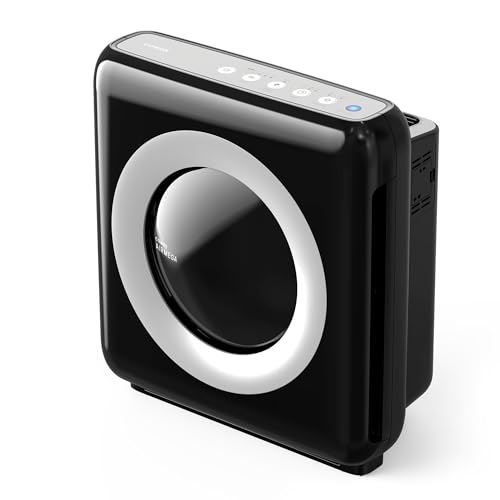
Coway AP-1512HH Mighty
This is a strong fit for bedrooms and medium living rooms where wildfire smoke is the main concern. Owners often report that the unit handles fine smoke particles well when the room is closed up and the filter is fresh.
Key specs
- True HEPA filter with a pre-filter and activated carbon layer
- Manufacturer-rated CADR for smoke in the mid-to-upper range for its class
- Covers rooms up to roughly 361 square feet per manufacturer guidance
- Three fan speeds plus an auto mode with air quality sensing
Pros
- Carbon stage helps with cooking and smoke odors
- Filter replacement indicator makes maintenance simple
- Quiet on low speed for overnight use
Cons
- Coverage shrinks noticeably in very large, open spaces
- Replacement filters add to the long-term running cost
Winix 5500-2
The Winix 5500-2 suits larger open-plan rooms where smoke from cooking and occasional wildfire events mixes together. It is a common choice for households that want a unit with both HEPA filtration and a carbon stage without extra features they will not use.
Key specs
- True HEPA filter plus activated carbon filter
- PlasmaWave ionization technology as a supplementary layer
- Designed for rooms up to roughly 360 square feet per manufacturer guidance
- Auto mode with a built-in air quality sensor
Pros
- Good balance of HEPA and carbon filtration
- Auto mode adjusts to changes in air quality
- Widely available replacement filters
Cons
- Some owners report the sensor responds slowly to sudden smoke spikes
- Larger footprint than compact bedroom models
Blueair Blue Pure 211+
This model is worth a look for people whose main complaint is smoke odor and chemical smells rather than just visible haze. Its layered pre-filter design is intended to capture particles and some gases before they reach the main filter.
Key specs
- Particle filter combined with activated carbon in a layered pre-filter
- Fabric pre-filter that can be washed or replaced
- Manufacturer-rated for rooms in the small-to-medium range
- Three fan speeds with low noise on the lowest setting
Pros
- Layered design helps with odor as well as particles
- Washable pre-filter lowers the cost of maintenance
- Compact and easy to place in a bedroom
Cons
- Coverage is limited for large rooms
- Filter sets can be pricier to replace over time than some competitors
Levoit Core 300
The Levoit Core 300 is a compact option for small bedrooms, dorm rooms and home offices. It is often chosen by buyers who want a three-stage filter without a large footprint or a complicated control panel.
Key specs
- Three-stage filtration with a pre-filter, true HEPA and activated carbon
- Designed for rooms up to roughly 219 square feet per manufacturer guidance
- Night light and sleep mode options
- Filter replacement reminder
Pros
- Very compact and easy to position
- Three-stage filter covers particles and odors
- Generally low noise on sleep mode
Cons
- Not suited for large rooms during heavy smoke events
- Carbon layer is smaller than in larger units, so heavy odor may need more runtime
Honeywell HPA300
The Honeywell HPA300 is aimed at larger rooms and whole-room coverage. It is a practical choice when a main living area or open-plan space needs to be cleared of smoke quickly.
Key specs
- True HEPA filter for fine particle capture
- Manufacturer-rated for large rooms, often cited around 465 square feet
- Multiple fan speeds with a filter change indicator
- Designed for continuous operation during smoke events
Pros
- Strong coverage for larger rooms
- True HEPA filtration suits fine smoke particles
- Simple controls
Cons
- Limited activated carbon capability compared with odor-focused models
- Bulkier than compact bedroom units
Dyson Purifier Cool Formaldehyde
This Dyson model is for buyers who want purification combined with a fan and gas monitoring. It appeals to people who want to see real-time readings of gases alongside particle data.
Key specs
- Sealed HEPA filter plus activated carbon for gases
- Real-time readings for gases and particles shown on the display
- Fan with oscillation and bladeless airflow
- App connectivity for monitoring
Pros
- Live gas and particle readings are useful during smoke events
- Combined fan and purifier saves space
- Well-known brand with broad service support
Cons
- Premium option with higher ongoing filter costs
- Fan noise on higher speeds can be noticeable
Medify MA-40
The Medify MA-40 is designed for medium rooms where quiet operation matters, especially overnight. Its dual H13 HEPA filter is intended for fine particle capture.
Key specs
- Dual H13 HEPA filter arrangement
- Manufacturer-rated for rooms in the medium range
- Sleep mode with very low noise on the lowest setting
- Filter change reminder
Pros
- Dual HEPA layers suit fine smoke particles
- Quiet on low speed for bedrooms
- Straightforward operation
Cons
- Limited odor-specific carbon compared with dedicated carbon-heavy units
- Coverage is less than the largest whole-room models
Buying Guide
Choosing a smoke and air purifier means balancing a few technical factors with your own space and habits. The guidance below explains what to check and how the numbers translate into real results.
Selection Criteria
Start with three questions: how big is the room, what kind of smoke you are dealing with, and how often you expect to run the unit. Wildfire smoke is mostly fine particles, so a true HEPA filter is the baseline. Cooking, incense and cigarette smoke also bring odors and gases, so an activated carbon stage becomes important.
Important Features
- True HEPA filter: Captures at least 99.97 percent of particles at 0.3 microns, according to the standard definition. Make sure the product says “true HEPA,” not “HEPA-type” or “HEPA-like.”
- Activated carbon: Adsorbs many odor molecules and some gases. The more carbon by weight, the longer it tends to last under heavy use.
- Auto mode with air quality sensing: Useful for adjusting speed as smoke levels change, though sensors vary in responsiveness.
- Filter change indicator: Helps you replace filters on time, which matters for smoke performance.
Specs to Check
- CADR (clean air delivery rate): Look at the smoke CADR, which measures how quickly the unit removes smoke particles. A common rule of thumb is to choose a CADR of about two-thirds of the room area in square feet for general dust and pollen, and a higher figure for heavy smoke. See our Air Purifier CADR Explained page for details.
- Room coverage: Use the manufacturer’s stated square footage as a starting point, and size up if you want faster cleaning.
- Noise level: Check decibel ratings on low and high speeds, especially for bedrooms.
- Filter life and replacement cost: Compare how often filters need replacing and what the sets cost over a year.
Choosing by Need
- Bedrooms and small rooms: Compact units with HEPA and a modest carbon layer, such as the Levoit Core 300 or Medify MA-40.
- Medium living rooms: Units with stronger carbon and a higher smoke CADR, such as the Coway AP-1512HH Mighty or Winix 5500-2.
- Large open-plan spaces: Whole-room models such as the Honeywell HPA300.
- Odor-sensitive households: Layered or carbon-heavy designs such as the Blueair Blue Pure 211+.
- Buyers who want live readings: Units with gas or particle displays such as the Dyson Purifier Cool Formaldehyde.
Things to Watch Out For
- Ozone-generating devices are not recommended for indoor use, and some ionizing units produce small amounts of ozone. Check the manufacturer’s ozone statement.
- A purifier does not replace ventilation or source control. Closing windows during smoke events and avoiding indoor smoking or candles will help more than any single unit.
- Filters that are saturated lose effectiveness. During heavy smoke periods, check filters more often.
- If you or someone in your home has asthma, a heart condition or another respiratory condition, talk to your doctor or an allergist before relying on a purifier for health protection.
FAQ
Does a smoke and air purifier remove the smell of smoke?
It can reduce smoke odor, but mainly when the unit includes a meaningful activated carbon stage. HEPA filters capture particles, while carbon adsorbs many odor molecules. Stronger, long-lasting smells from heavy smoke usually take longer to clear.
What CADR do I need for wildfire smoke?
Use the smoke CADR rating, not the dust or pollen figure, and aim for a number high enough for your room size. Many guides suggest a CADR around two-thirds of your room area in square feet as a baseline, with a higher target for heavy smoke.
Is a true HEPA filter enough for smoke?
A true HEPA filter is essential for fine smoke particles, but it does not capture most gases. For cooking, incense and cigarette smoke, a carbon stage is strongly recommended.
How often should I replace the filter after a smoke event?
Check the filter after the event. If it looks dark or has a strong smell, replace it. Manufacturers usually give a general replacement interval, but heavy smoke can shorten that window.
Can I run a purifier continuously during wildfire season?
Many people run units on a low or auto setting continuously during smoke events. Check the unit’s noise level and energy use, and keep an eye on the filter indicator, since continuous use wears filters faster.
Do I need to close windows when using a smoke purifier?
Yes, closing windows and doors helps the purifier keep up with incoming smoke. Opening windows lets outdoor smoke in faster than the unit can clean it.
Should I consult a professional about smoke exposure?
If anyone in your household has asthma, heart disease, COPD or is pregnant, or if symptoms such as coughing, wheezing or chest discomfort appear, consult a doctor or healthcare professional. A purifier supports clean indoor air but is not medical treatment.
Conclusion
For most smoke situations, a true HEPA filter combined with a meaningful activated carbon stage is the right starting point. The Coway AP-1512HH Mighty and Winix 5500-2 suit medium to larger living spaces dealing with both particles and odors. The Levoit Core 300 and Medify MA-40 fit smaller bedrooms, while the Honeywell HPA300 is better for large open rooms. The Blueair Blue Pure 211+ is a good choice for odor-sensitive households, and the Dyson Purifier Cool Formaldehyde suits buyers who want live gas and particle readings. Match the smoke CADR and room coverage to your space, check filter costs, and remember that ventilation and source control matter as much as the purifier itself.